

First Misfit Haute Couture Show
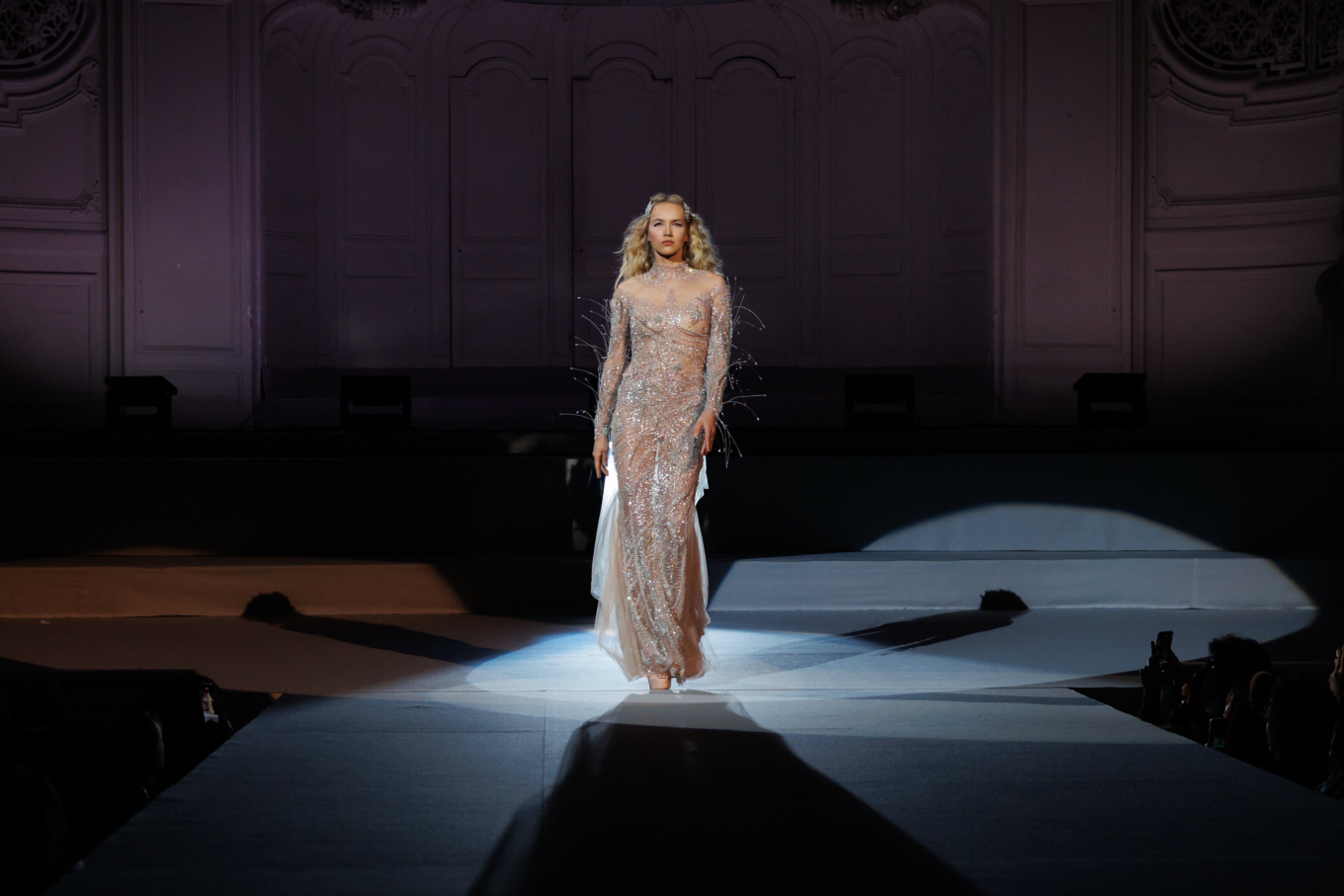
A Made-to-Measure Creation for a Single Client
In a world where fashion races ahead, Haute Couture remains a bastion of elegance and authenticity. A Haute Couture gown is not a garment: it is a work of art. Made to measure for a single client, it is born of an intimate dialogue between the house and the woman who will wear it — shaped to her measurements, of course, but also to her personality, her way of life, her most singular desires.
Haute Couture does not follow trends: it transcends them. It does not seek to please everyone, but to elevate individuality. It is an almost secret luxury, where every detail is a decision.
Haute Couture: An Appellation Protected by French Law
The term “Haute Couture” is strictly governed by French legislation. Only a few houses may claim it, after approval by the Ministry of Industry on the recommendation of the Chambre Syndicale de la Haute Couture. Among these rare few: Chanel, Dior, Julien Fournié. To earn this title, a house must satisfy four cumulative conditions:
- Maintain an atelier in Paris with a minimum number of qualified artisans.
- Present collections on a regular basis.
- Offer creations made exclusively to measure for a private clientele.
- Employ and train the “petites mains” who keep rare crafts alive.
The Origins of Haute Couture
Haute Couture was born in Paris in the mid-19th century. Its paternity is attributed to the English couturier Charles Frederick Worth, who opened his house on the rue de la Paix in 1858: he was the first to impose his signature, to present his designs on live models, and to make the couturier a creator in his own right rather than a mere executant. It was he who founded, in 1868, the Chambre Syndicale de la Couture, forerunner of today's Fédération de la Haute Couture et de la Mode.
The appellation itself has been governed by French law since a 1945 decree, which reserves its use for houses meeting strict criteria, reviewed every year. It is this legal protection — unique in the world — that sets Haute Couture apart from every other segment of fashion: no one may call themselves “Haute Couture” without official approval. Nearly one hundred and fifty years after Worth, the House of Julien Fournié carries on this heritage, admitted to official Haute Couture status in 2017.
The Artisan Crafts of Haute Couture
Haute Couture rests on an ecosystem of rare and precious crafts. Embroiderers, feather workers, corset makers, pleaters, bootmakers: these artisans perpetuate age-old gestures, handed down from generation to generation.
Each gown can call for hundreds, even thousands of hours of work. Fabrics are often woven specially for the collection. Embroidery is done by hand, bead after bead. Nothing is left to chance. Haute Couture is the intelligence of the hand in the service of the imagination.
Haute Couture and Sustainable Fashion
At a time when the fashion industry is called to account for its environmental impact, Haute Couture stands as a model of quiet sustainability. Unlike luxury ready-to-wear — which produces in bulk and generates unsold stock — it manufactures only to order. It does not waste. It does not destroy.
It favours natural materials, short supply chains, local craftsmanship. It values the long term, quality, transmission. It trains the new generations of artisans and helps safeguard an irreplaceable intangible heritage.
The Revival of Haute Couture
For the past decade or so, Haute Couture has enjoyed a genuine resurgence. Driven by an international clientele in search of authenticity, it has regained a centrality in the world of luxury that no one would have dared predict. This ultra-demanding clientele is not merely looking for a garment: it seeks an experience, a story, an emotion. Haute Couture answers that call. It embodies strong values — exclusivity, creativity, sustainability, excellence — and restores meaning to the very act of creation.
Haute Couture is the ultimate expression of a luxury that is sincere, exacting, profoundly human. A luxury that does not merely make us dream — but gives that dream substance, thread by thread, hand by hand.
Haute Couture or Ready-to-Wear: What Are the Differences?
| Criteria | Haute Couture | Ready-to-wear |
|---|---|---|
| Production | Made to measure, one-of-a-kind | Mass-produced, standard sizes |
| Craftsmanship | Almost entirely by hand | Largely industrial |
| Location | Approved Paris atelier | Factories, often offshore |
| Lead time | From dozens to thousands of hours | Fast, high-volume production |
| Clientele | Private, by appointment | General public, in store |
| Appellation | Protected by French law | Unregulated, free to use |
| Environmental impact | Made to order, no unsold stock | Overproduction, unsold stock destroyed |
FAQ
Julien Fournié Haute Couture
Our Haute Couture advisors are at your disposal for any enquiry regarding a collection or a bespoke creation.
More than a fashion brand, Maison Julien Fournié is a luxury experience that transcends trends and seasons. With a commitment to excellence and innovation, Julien Fournié continues to redefine the world of ultra-luxury.
Julien Fournié was founded in 2009.
The history of the house is reflected in its haute couture collections, which are presented in Paris every January and July during Haute Couture Week.
For his first collection, the young couturier was awarded the Grand Prize for Creativity by the City of Paris in January 2010.
For his fourth collection, in January 2011, Julien Fournié became a "guest member" of the official calendar of the Chambre Syndicale de la Haute Couture catwalk shows. This was the first step towards recognizing Julien Fournié as a promising new brand in the circle of the great couturiers.
In January 2017, the Julien Fournié house was officially classified as "Haute Couture". This label, protected by the French Ministry of Industry, is awarded to a few houses (only ten prestigious Haute Couture houses are currently on this list) that combine the best creativity in design and the highest quality in garment making.
Since its inception, Julien Fournié has also had the honor of being invited to show its collections at prestigious events abroad, in order to bring the couturier's style to luxury clients from all over the world.
In March 2023, a Julien Fournié dress, worn by the actress Audrey Fleurot, entered the Grévin Museum in Paris.
In April 2023, the first retrospective of Julien Fournié's work will be held at SCAD Lacoste in an exhibition entitled "Haute Couture un point c'est tout".
While respecting tradition, Julien Fournié has also forged new partnerships with high-tech giants such as Apple and Tencent.
Julien Fournié has thus been able to digitize the creation, design and personalization of his haute couture pieces. He is one of the few haute couture designers to master the new digital tools.
Long regarded as a survivor of a bygone era, the haute couture market has experienced a new boom in recent years. Thanks to new technologies, Julien Fournié has been able to establish direct and unique means of communication with his clients. It is no longer a question of sending a sketch to the client for approval, as was the case in the past.
Julien Fournié has introduced a new process in which clients are no longer mere spectators of the creative process. They have become actors in the unique experience of creating a garment wherever they are.
Since December 2020, Julien Fournié has been developing a line of luxury bags and accessories. Initially, the idea was to offer handbags that could be seen in Julien Fournié shows and were previously reserved for haute couture customers.