
Chapter 27 — Haute Couture Outfit’s Secrets
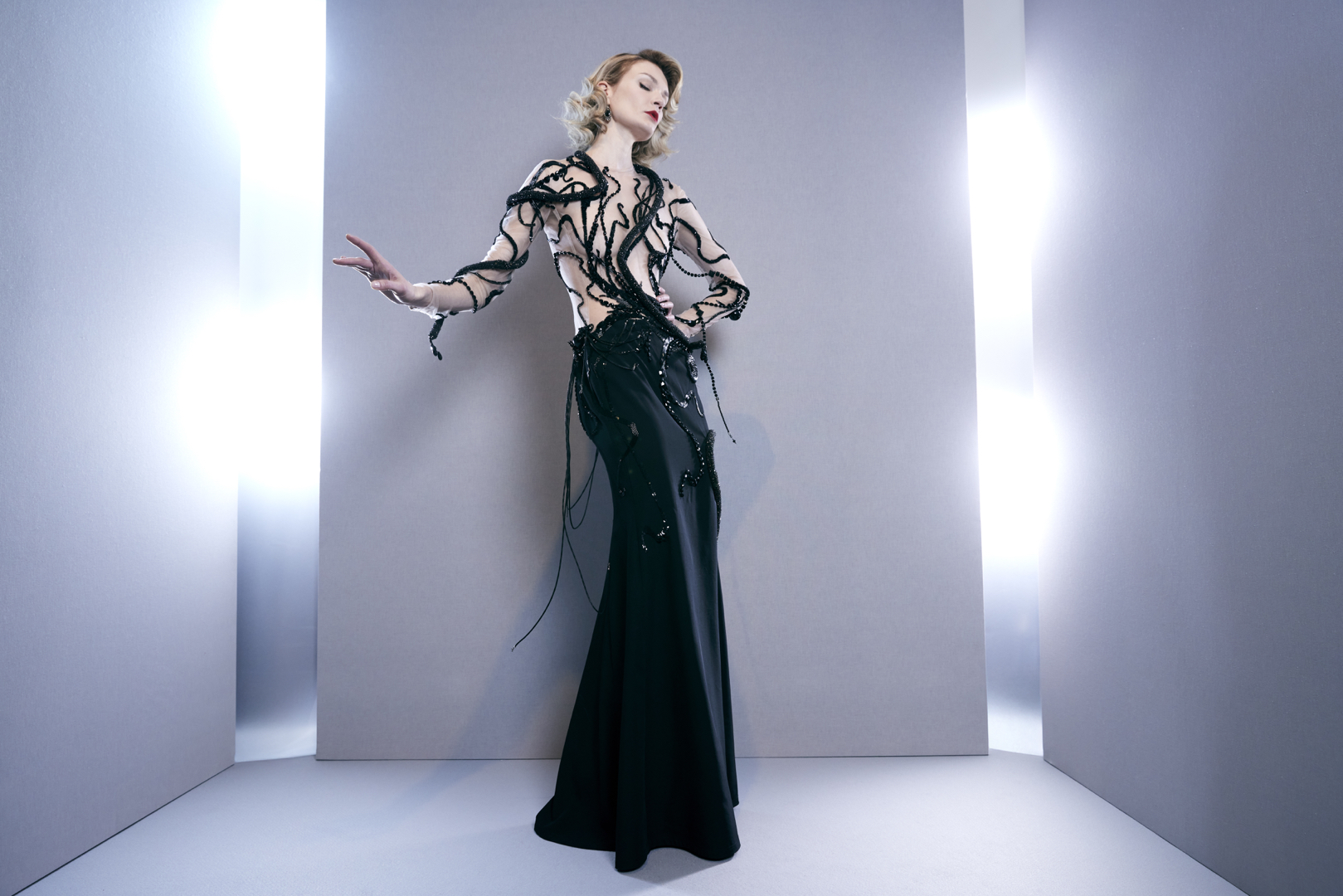
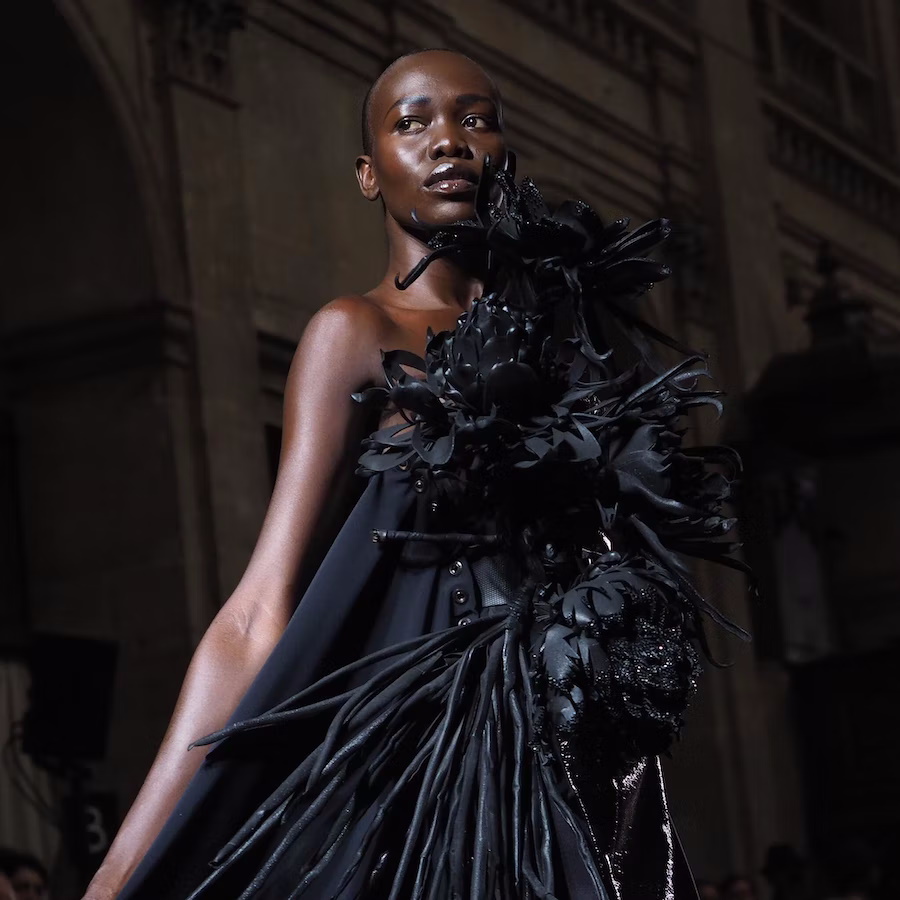
Haute couture embroidery is what separates a runway gown from every other dress: worked by hand, built in relief, made for one body only. The Kraken dress from the First Misfits collection by Maison Julien Fournié is the proof — four and a half months of work, tentacles embroidered in three dimensions from jet stone, set on nude tulle above a sheath skirt in black grain de poudre wool. A creature that closes around the body in order to reveal its line.
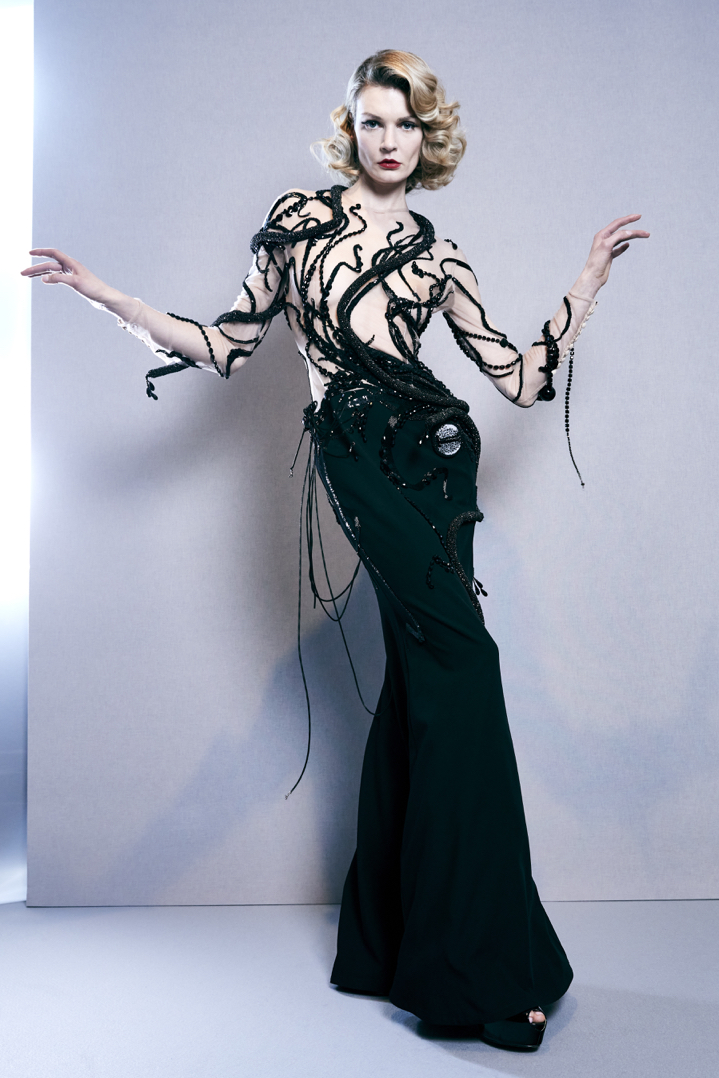
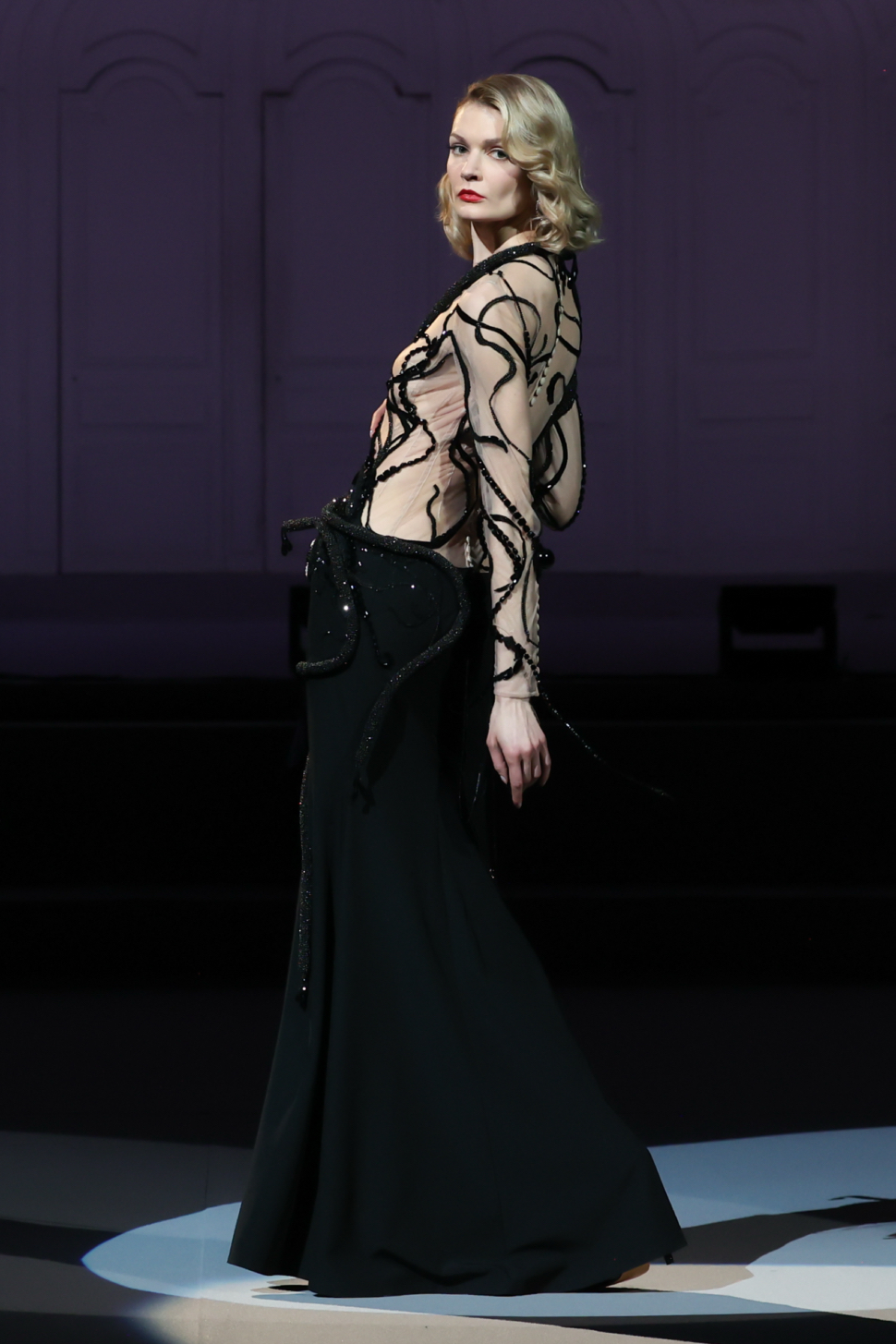
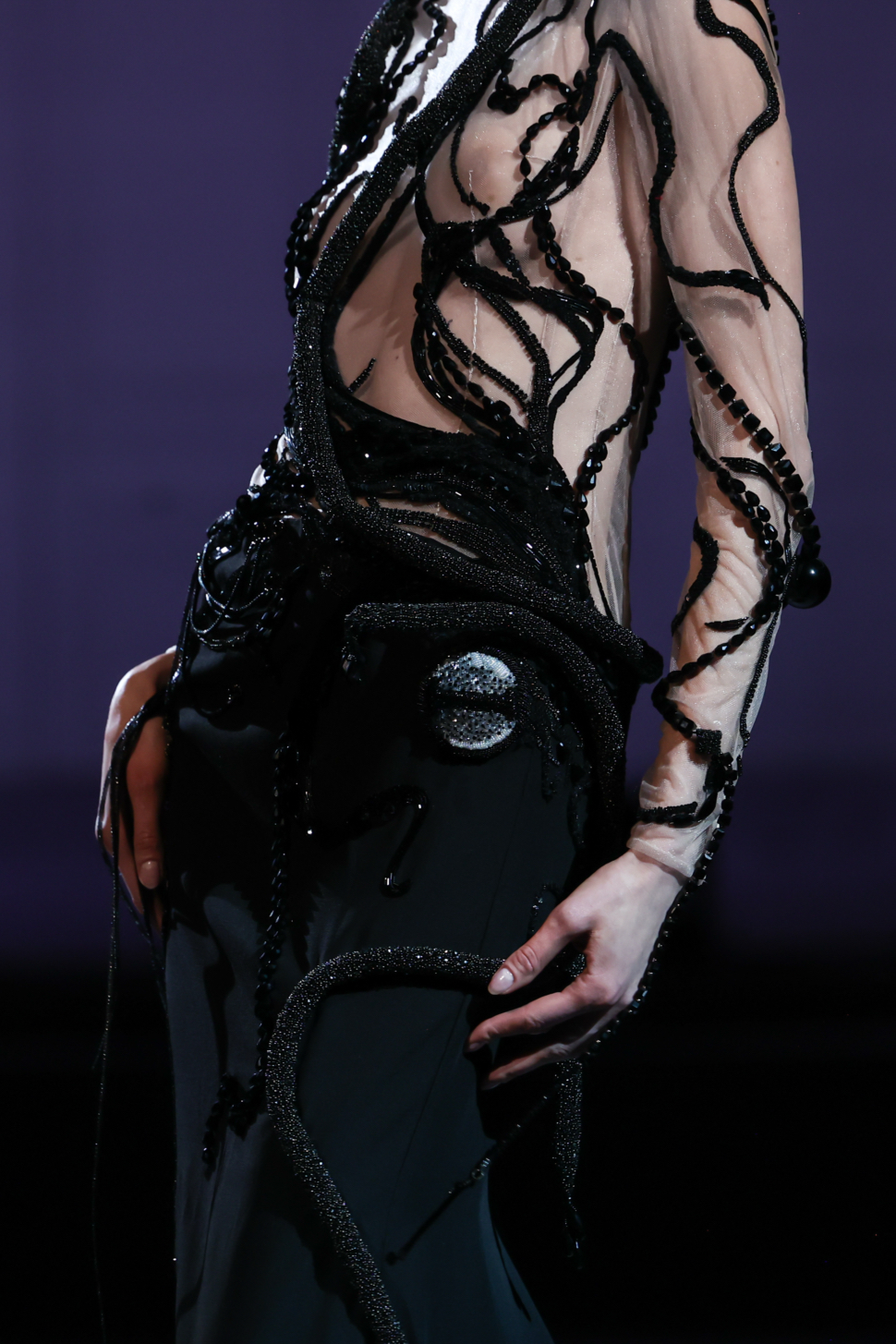
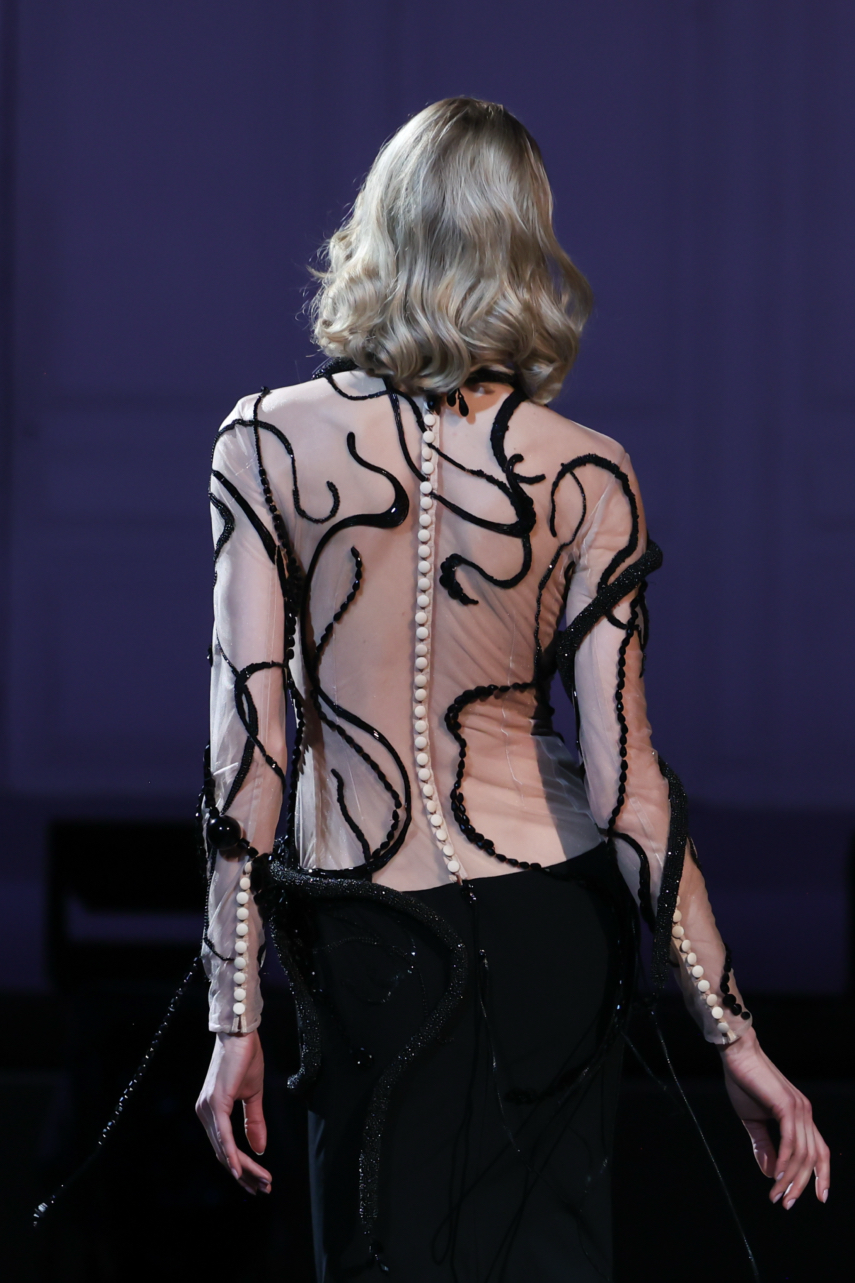
Kraken Haute Couture sheath dress — nude tulle bodice, black wool skirt, pirated with three-dimensional jet tentacle embroidery
- How was the Kraken Haute Couture dress imagined?
- What is it made of?
- How was the tentacle embroidery built?
- Why jet stone?
- How long did it take to make?
- Who wore it on the runway?
Haute Couture Outfit’s Secrets: the Kraken dress from First Misfits
The Kraken on this dress does not attack. It absorbs. It climbs the body, wraps it, follows it, and the tighter it holds the more clearly the line appears. That is the whole subject: a creature whose embrace threatens nothing and draws everything. The tentacles do not cover the woman. They underline her.
A monster from the North
English readers know the Kraken from pirate films and sea shanties, but it is not a Mediterranean creature at all. It comes from cold water — from the Norse sagas, and from the accounts of eighteenth-century Norwegian sailors who swore they had seen an island move. It is a creature of fog and hearsay: no two people have ever described it the same way. That is exactly what interests me in a garment. A silhouette you cannot take in at a glance, whose arms you discover one by one as you walk around it.
And voices from the Mediterranean
The sirens come from the other end of the world. They sing in Book XII of the Odyssey, and Odysseus has himself lashed to the mast so he can hear them without being lost. A few lines later, in the same book, he passes Scylla and her six necks. Homer had already written the many-armed creature a thousand years before the North gave it a name. I crossed the two mythologies because they say the same thing: we move towards what fascinates us, and we do it knowing exactly what it is.
The line: Art Nouveau, and Erté
The drawing itself does not come from the sea. It comes from Art Nouveau — its arabesques, its climbing stems that refuse the right angle — and above all from Erté, the Russian-born illustrator who shaped the look of Harper’s Bazaar for more than two hundred covers. His women are held inside a single unbroken black line that runs from wrist to ankle without ever stopping. A tentacle, in the end, is that line. A curve with no beginning and no end, following the body instead of contradicting it.
Nudity as a lure
The bodice is nude tulle. From a distance, on the runway, you do not see it. You believe you are seeing skin. The whole difficulty of nude tulle in haute couture is there: it must not look like the flesh-coloured mesh of a leotard. It has to disappear. The seams are built not to exist; the armholes follow the anatomy. On that supposed skin, the creature can then be written like a drawing made directly on the body.
The tentacles and their souls
The embroidery was designed with a three-dimensional effect so that the dress would close around the body. It is not laid flat on the fabric: it lifts off, coils around the arm, runs back down the spine, and in places leaves the garment altogether to hang free and move as the woman walks. To build that relief, the embroidery house Amman slipped what the trade calls âmes inside certain tentacles — literally souls: a core laid beneath the stitch that gives the form its swell and its hold. English calls this padding, which says nothing. The French word says everything: the creature has a soul, quite literally, under the embroiderer’s hand.
The path is never symmetrical. A Kraken does not organise itself. The arms rise on one side, cross the torso, take one hip, spare the other. It is a grip, not a repeated motif.
Jet, the protective stone
The embroidery is built from jet. That is not a decorative choice. Jet has long been held to be a protective stone, credited with drawing off bad energy and holding it — the reason Victorian England wore Whitby jet through mourning. The entire dress is made of that material. The creature everyone finds unsettling is in fact a suit of armour: what closes around the woman is also what protects her.
The eye that never sleeps
On the hip, one pale point in the whole silhouette. It is not a jewel and not an ornament: it is the eye of the Kraken, and it never sleeps. It had to sit there, at hand height, exactly where the gaze settles when the woman stops moving. The rest of the dress is in motion. The eye holds still.
Grain de poudre, and deep water
Below the waist, the sheath skirt is cut in grain de poudre — a dry, tightly woven worsted wool, matte and mineral, that falls straight and refuses the light. The contrast is deliberate: above, the tulle that vanishes; below, the material that holds. That black is deep water. Nothing else. The dress narrows along the leg and then opens at the floor like a tail fin — the one moment where I let the mermaid take the creature’s place.
The tentacles run all the way down. They cross the waistline and write themselves in jet across the black wool, visible only on the diagonal, when the light rakes across the cloth. That discretion was necessary: a dress embroidered everywhere would have stopped telling a story.
The word “pirated”
One word keeps coming back in this collection: pirated. First Misfits is a story of buccaneering, of tattoos, of signs borrowed and turned to other ends. This dress is pirated in the graphic sense: a creature has written itself across it, like a tattoo that took up all the room.
Alex Mart
Alex Mart wore it. She has worked with the house for more than ten years — a muse, and a friend. A dress like this one is not handed to a stranger. It needs someone who understands what the creature is asking for, and who wears it rather than being worn by it.
Julien Fournié
Secrets of the Kraken dress
How was the Kraken Haute Couture dress imagined?
Julien Fournié designed this twenty-sixth look of the First Misfits collection by crossing two sea mythologies — the Kraken of the Norse sagas, and Homer’s creatures, the sirens of Book XII of the Odyssey and many-necked Scylla — with a graphic source: Art Nouveau, and the illustrations of Erté, whose unbroken black line wraps the body without ever stopping. The principle of the dress follows from that: a creature that absorbs the woman and underlines her curves rather than hiding them.
What is the Kraken Haute Couture dress made of?
A nude tulle bodice, which reads as bare skin from a distance, above a sheath skirt in black grain de poudre — a dry, tightly woven worsted wool. The whole is embroidered with tentacles built in relief from jet stone, extended by free-hanging cords, and marked at the hip by the eye of the Kraken, the only pale point in the silhouette.
How was the tentacle embroidery built?
The embroidery was designed with a three-dimensional effect so that the dress would close around the body. Unlike flat embroidery, each tentacle is built as a volume: the embroidery house Amman slipped cores — âmes in the French trade term — inside certain pieces to give them swell and hold, and several segments are fixed at one end only so they stay mobile. That relief is what makes the creature appear to tighten around the body as the wearer walks.
Why jet stone?
Jet has long been considered a protective stone, credited with absorbing bad energy — the belief behind Victorian mourning jewellery in Whitby jet. The choice is therefore not only aesthetic: the creature that closes around the woman is also what shields her.
How long did the Kraken dress take to make?
Four and a half months in total. Six weeks of creative research to draw the exact motifs, two months at the Amman embroidery house to work the separate sections, then one month of assembly entirely by hand, adjusted fitting by fitting.
Who wore the Kraken dress on the runway?
Alex Mart, a model who has worked with Maison Julien Fournié for more than ten years, at the First Misfits Haute Couture show in Paris.
Which collection does the Kraken dress belong to?
The First Misfits Haute Couture collection by Maison Julien Fournié, a Paris house that has held the officially protected “Haute Couture” designation since 2017 — a label granted by the French Ministry of Industry and the Fédération de la Haute Couture et de la Mode to roughly a dozen houses worldwide.
More secrets
- The Fireworks dress — First Misfits
- Magie Noire — a masterpiece of technicality
- How is a Haute Couture dress made?
- All Haute Couture Outfit’s Secrets
Handbags, tote bags, and clutches created by Julien Fournié